Mocksmith: the mock API I wanted on every project
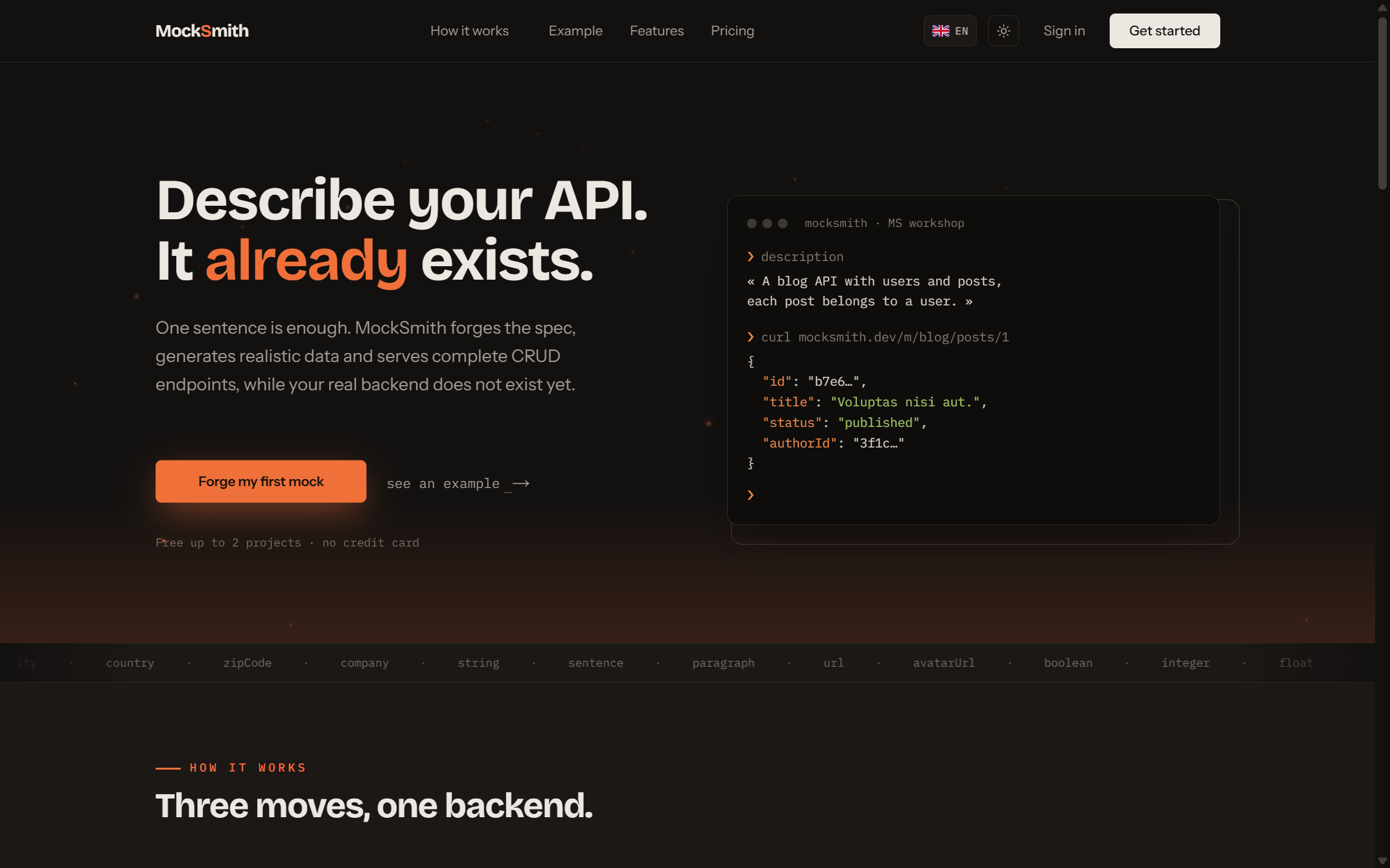
The front-end is ready, the backend doesn't exist yet. Mocksmith forges the spec from a description or a visual builder, then serves real CRUD endpoints. My first product with real billing.
The problem I hit on almost every project
The scenario keeps coming back: the front-end is ready to consume an API, but the backend doesn't exist yet. The contract isn't frozen, the backend team is on something else, or I'm on my own and just don't feel like building everything in order. So you improvise. A frozen JSON file imported by hand, a fake Express server coded for the occasion, hard-coded data in the component, or worse: you wait for the real backend to land.
Each of these patches has the same flaw. It doesn't do CRUD: you can't really create, edit, delete and watch the state change. And it doesn't last: as soon as the need grows, the patch becomes a project to maintain on the side.
The grid says Painkiller
Before coding, I always run my idea through my validation grid. For Mocksmith, the verdict is immediate.
| Question | Answer |
|---|---|
| Is the problem real and frequent? | Yes, I hit it on nearly all my projects |
| Are people already paying to solve it? | Yes, API mocking is an established market (Mockoon, Beeceptor, Postman) |
| Does the promise fit in one sentence? | "Describe your API, it already exists" |
A Painkiller for developers, and like Calmora, user number one is me. The difference with Inkindly, which I dropped because the topic didn't speak to me: here I'm squarely in my own domain. Front-end developers waiting on a backend, I know where they hang out and I speak their language.
What Mocksmith does
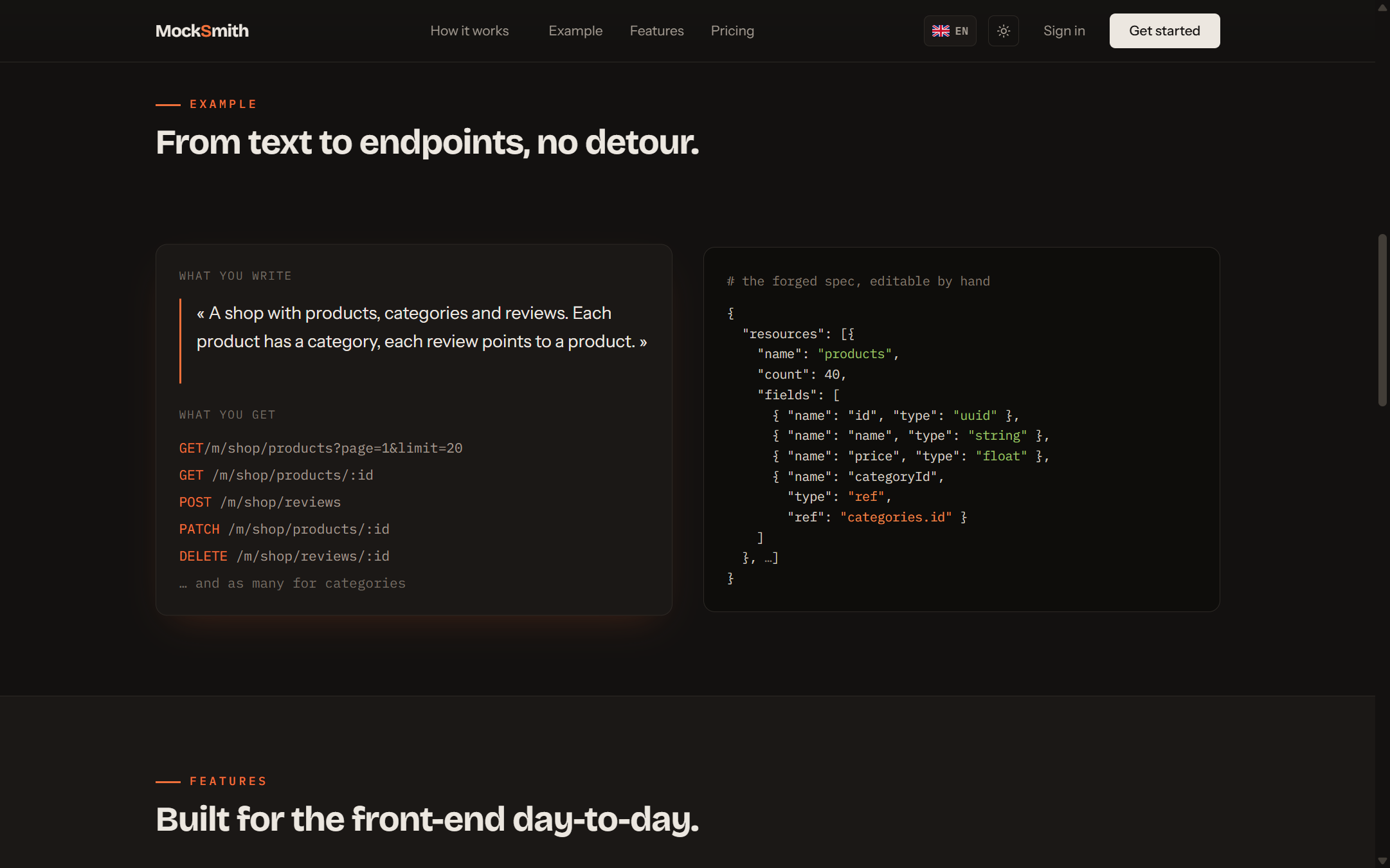
Mocksmith takes a spec and turns it into a working API. Two ways to reach that spec:
- The visual builder: you declare your resources, your fields, their types from 94 generators (name, email, country, past date, avatar URL, integer, float...), with value ranges, constants, compliance regex and relations between resources.
- The plain-language description (Pro plan): you write what you want, the AI forges the spec, and you fix it up if needed.
From there, Mocksmith serves full CRUD endpoints, with pagination and optional Bearer-key protection:
GET    /m/:slug/users?page=1&limit=20
GET    /m/:slug/users/:id
POST   /m/:slug/users
PUT    /m/:slug/users/:id
PATCH  /m/:slug/users/:id
DELETE /m/:slug/users/:id
Two strictly separated paths
The heart of the architecture is a separation I imposed from day one: generation and serving share nothing.
| Path | When | Speed | LLM |
|---|---|---|---|
| Generation | Once, at creation | Slow, doesn't matter | Yes (Pro plan), the only call site |
| Runtime | On every mock request | Fast, deterministic | Never |
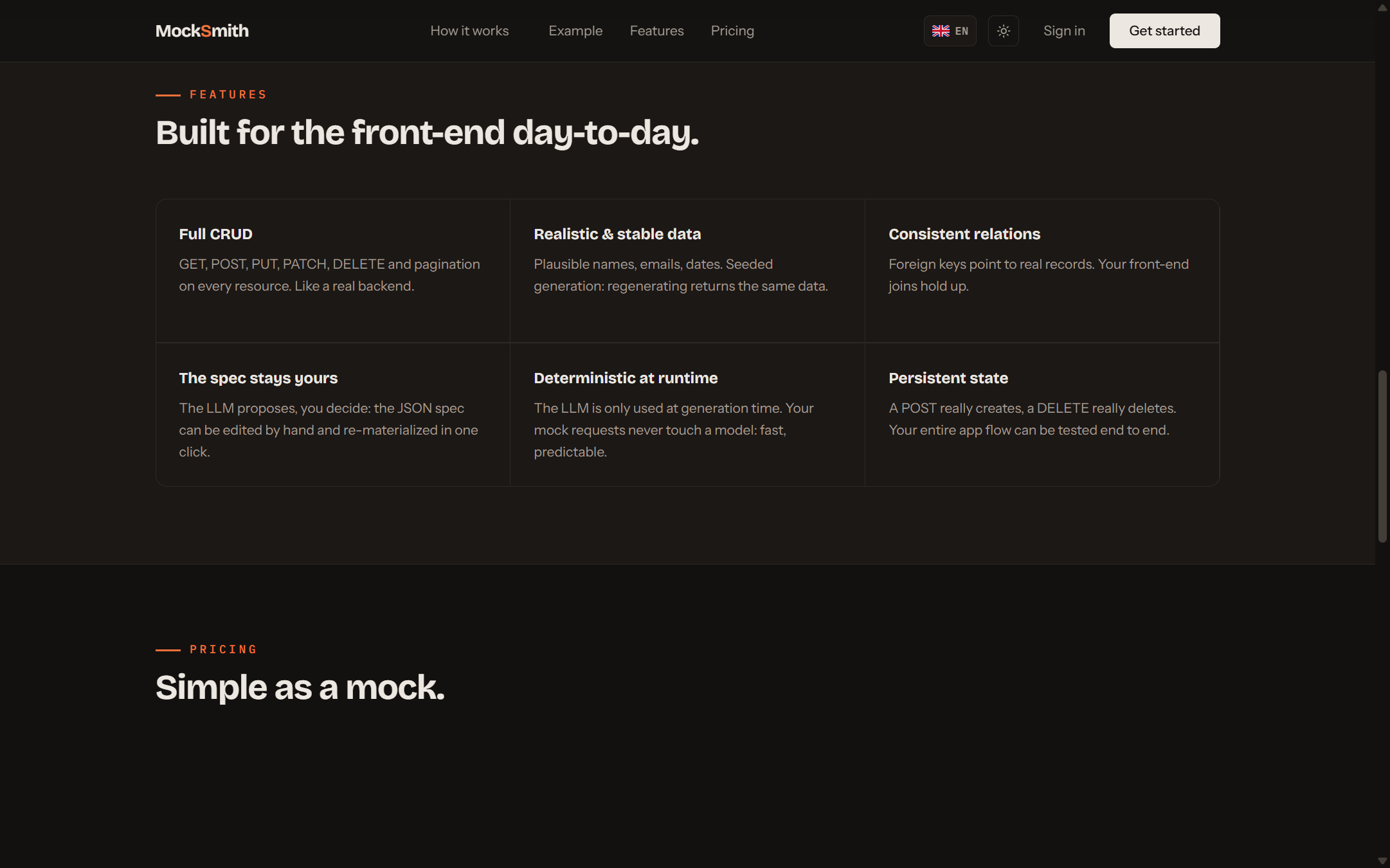
Concretely: when your front-end hits GET /m/:slug/users, no AI is involved. Mocksmith reads the spec and the data already materialised in the database, applies the CRUD logic and responds. The LLM only steps in when you forge the spec, never when you consume the API. That's what makes responses fast, predictable and free to serve.
Realistic, stable data
The classic mock trap is data that changes on every reload: you can't write a test against it. Mocksmith generates its data with a seeded faker and resolves regex deterministically. The same spec always returns exactly the same data. A POST really creates a record, a DELETE really removes it, and the state persists between requests. The front-end behaves as if facing a real backend, without the surprise of a dataset that rewrites itself.
My first real pricing
Calmora isn't out, Inkindly was dropped. Mocksmith is the first project I'm pushing all the way to billing, wired to Stripe.
| Free | Pro | |
|---|---|---|
| Visual builder, 94 types, CRUD, pagination, Bearer keys | Yes | Yes |
| Projects | 2 | Unlimited |
| AI generation from a description | No | Yes |
| Network simulation (latency, random errors) | No | Yes |
| Pinned responses per endpoint | No | Yes |
| Price | 0 € | 2.99 € / month |
The free plan is deliberately usable for real: the whole builder, CRUD and API-key flow works without paying. The AI gating is enforced server-side, not just hidden in the UI.
What Mocksmith is not
It's not a replacement for your production backend, nor a contract-testing tool, nor an API gateway. It's scaffolding: it holds while the real backend is being built, and it steps aside once that backend is ready. The promise stops there, and that's on purpose.
What's next
Mocksmith is live at mocksmith.lioncore.dev, and the full write-up is on the project page. For once I'm not waiting for a signal to publish: it's already done. If you try the app and hit a case Mocksmith doesn't cover yet, write to me, that's exactly what shapes what comes next.